

Retail banking KYC onboarding is where a new customer’s relationship with a bank begins. This use case looks at how a bank can make retail banking KYC onboarding faster for genuine customers while still completing every check the rules require.
On this page
Retail banks opening new savings and current accounts were relying on branch staff to manually check PAN cards and Aadhaar documents against physical copies or slow third-party lookups. Every new account took anywhere from a few hours to a full day to activate, and a large share of applicants dropped off before completing the process.
The Challenge
- Manual PAN and Aadhaar checks meant staff had to re-key data from photographed documents
- No instant way to confirm a submitted Aadhaar number matched the applicant's identity
- Peak hours saw account-opening queues back up at branches

The Solution
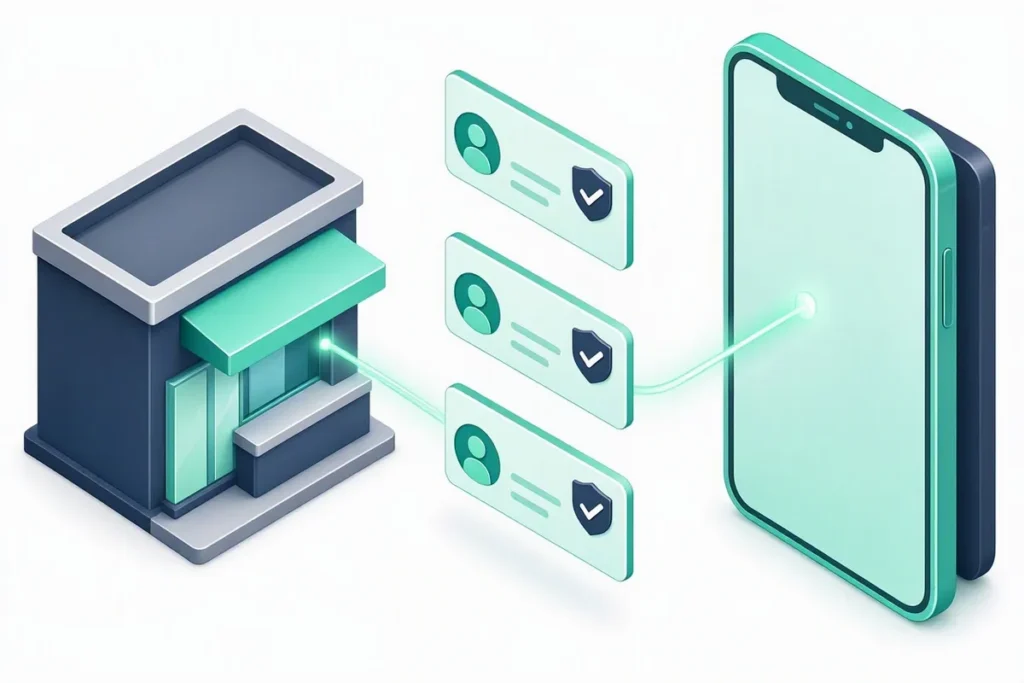
Veriqos Technologies' PAN and Aadhaar verification APIs were integrated directly into the bank's account-opening flow, both at the branch and in its mobile app. Submitted details are validated in real time against source records, so staff no longer manually cross-check documents.

The Results
Account activation time dropped from up to a full working day to just a few minutes for most applicants, and branch staff redirected their time toward customer service instead of paperwork.
Getting retail banking KYC onboarding right
Retail banking KYC onboarding is the first experience a new customer has with a bank, and for many it decides whether they finish opening the account at all. The approach in this use case focuses on removing waiting and repeated requests while keeping every check the rules require. These principles apply to most teams improving retail banking KYC onboarding.
Use source data instead of uploads
Uploaded photos of documents are slow to review and easy to edit. Retrieving data from the source, through DigiLocker-based Aadhaar verification and PAN verification, gives the bank confirmed information and spares the customer from photographing cards.
Choose the route by product
Not every account needs the same route. Retail banking KYC onboarding can use lighter routes for accounts that permit them and reserve video-based identification for accounts that require an in-person-equivalent check. Matching the route to the product keeps the journey short for most customers.
Remove the waiting
- Run independent checks at the same time rather than one after another.
- Return results to the customer on screen rather than by follow-up email.
- Ask for missing information once, clearly, instead of in several rounds.
Teams that apply these principles to retail banking KYC onboarding usually see the biggest gains at the steps where customers used to wait. The rules for each route are set out in the RBI’s Master Direction on KYC.
Communicating with the customer
Customers abandon onboarding when they do not know what comes next. Show a simple progress indicator, tell them how long each step takes, and explain why each piece of information is needed. If a check fails, say exactly what to fix. Clear communication is one of the cheapest improvements a bank can make to retail banking KYC onboarding, because it reduces both drop-off and support calls.
More about Retail Banking KYC Onboarding
To learn more about Retail Banking KYC Onboarding, explore our Bank Account Verification API and Penny Drop Verification API, or talk to our team. For the official source, see the Reserve Bank of India website.